OntoMesh — A Structural Map

Phase · Boundary · Stopping · Completion

A Structural Map for Reading Applicability, Sufficiency, and the Limits of Continuation

(Phase as Grammar · Boundary as Requirement · Stopping as Structure · Completion as State)

OntoMesh is presented here as a boundary-explicit reading framework: it approaches systems not in terms of goals, outputs, or progression, but in terms of applicability, sufficiency, and structural termination.

This series is intentionally positioned away from theory construction, normative prescription, and action-oriented synthesis.

It maintains a stable descriptive layout across existing documents so that one can observe where structures stabilize, where continuation loses validity, and what remains once generative demand is no longer required.

Within this framing, stopping and completion are treated not as failure or negation, but as structural states that may emerge when generation, recursion, and expansion have exhausted their functional role.

This page does not prioritize novelty. Its only test is legibility: whether the map clarifies applicability, breakdown, and sufficiency in the reader’s own observations.

OntoMesh: A Structural Map for Reading Systems — UPO, PSRT v2.1, Stopping as Structure, Ontology of Completion
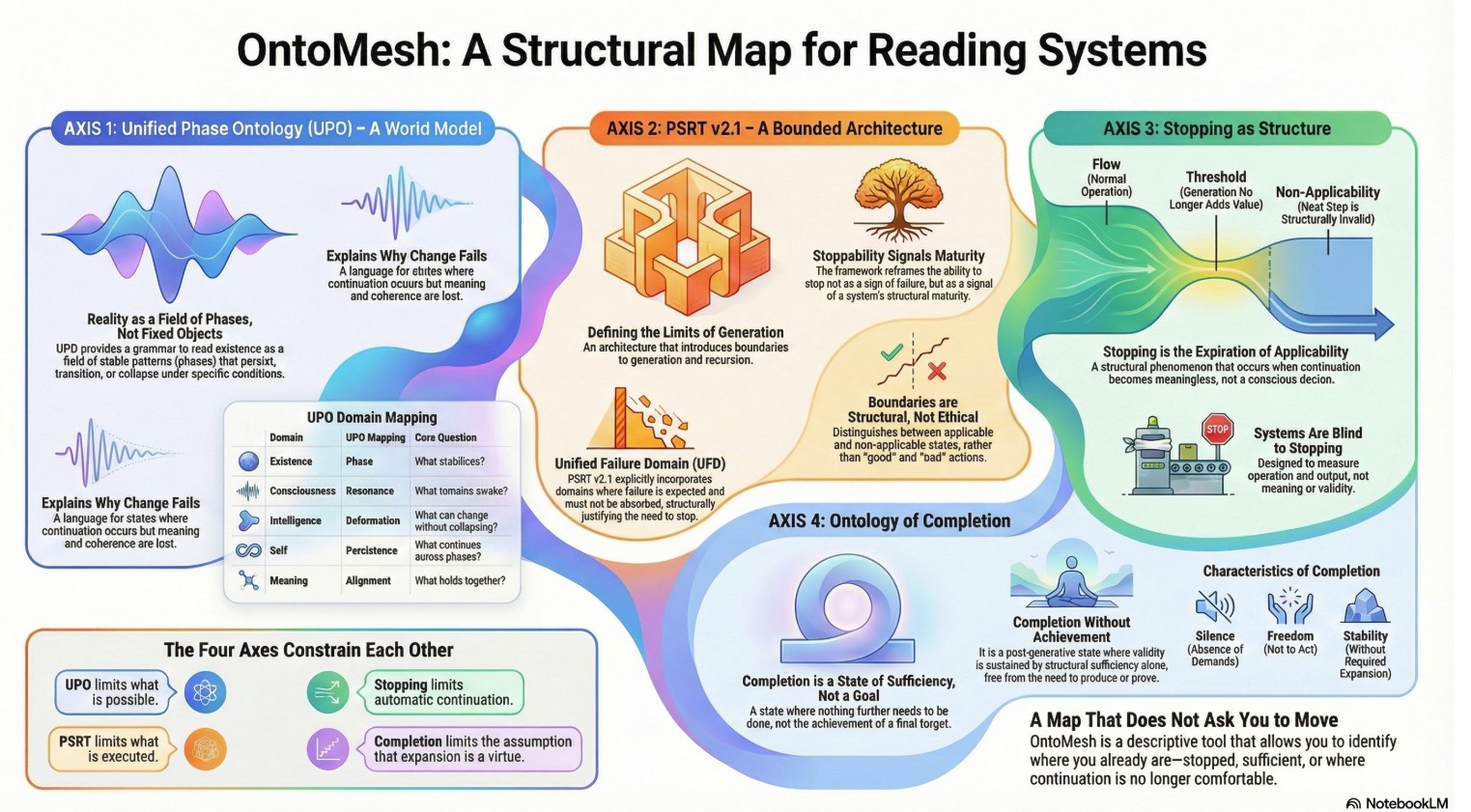
OntoMesh visual overview. A structural map for reading applicability, boundary, stopping, and sufficiency — not a system diagram, workflow, or execution model.
Scope
Reading axes — Phase / Boundary / Stopping / Completion
Background frame: process (this map is positioned after process-based accounts, not prior to them)
Applicability · Sufficiency · Structural Remaining
Use this map to locate where continuation remains valid, where applicability expires, and what remains once sufficiency is reached.
Structural Freeze Date
2025-12-22

DOI: 10.5281/zenodo.18012519

References (DOI)
Process–Structure–Recursion Theory (PSRT v2.1 — Main) — 10.5281/zenodo.17932629
Unified Phase Ontology (UPO) — 10.5281/zenodo.17656373
Stopping as Structure — 10.5281/zenodo.17984405
Ontology of Completion — 10.5281/zenodo.17960364
Author
OntoMesh (Editorial layout / descriptive indexing)
Status
Structural Map · Boundary-Explicit · Non-Prescriptive · Post-Generative
Operational Constraint
This framework does not instruct expansion, recursive execution, or prescriptive action. It marks limits of applicability and conditions of sufficiency, without requiring execution.
Philosophical Position
Post-Teleological · State-Oriented · Non-Directive

This document does not declare a system, doctrine, or method. It places an already-sufficient structure into a stable descriptive form.

Contents

Part I — The World Model (UPO)

Part II — Structure and Boundary (PSRT v2.1)

Part III — Stopping

Part IV — Completion

Part V — Alignment (Structural Reading)

Closing

0. How to Read This Series

Why This Is a Map, Not a Doctrine

This series is not written to propose a theory, nor to persuade the reader to adopt a belief system or interpretive position.

The concepts discussed here—UPO, PSRT v2.1, Stopping as Structure, and Ontology of Completion— do not form a single unified argument. They are independent structural references, placed in a shared layout for reading reality from different levels and angles.

The purpose of this series is not to state what is correct or preferable, but to provide a map that makes it possible to identify where structures function, and where they no longer do.

Why This Is Not a Theoretical Proposal

This series does not ask for reinterpretation, agreement, acceptance, or belief.

Each text is concerned only with a small set of questions:

These questions do not demand conclusions. They require only observability and explainability.

Why Structure, Not Generation

Many contemporary systems—technology, institutions, AI, and discourse—are organized around the assumption that more can always be generated.

This series asks a different question: not whether generation is possible, but whether it remains structurally valid.

In this context, structure refers to:

Structure, in this sense, is a language for describing the conditions under which continuation no longer produces coherence or meaning.

The Four Axes of the Series

This series is organized around four distinct structural reference axes.

UPO (Unified Phase Ontology)

A world model that reads reality not as fixed objects, but as a field of phases and regime transitions.

PSRT v2.1

A boundary-explicit integration architecture that introduces limits on generation and recursion.

Stopping as Structure

A structural reference that treats stopping not as a decision or ethical judgment, but as the expiration of applicability.

Ontology of Completion

A post-sufficient reference describing what remains once adequacy has been reached— without goals, outcomes, or achievement.

These four axes do not extend one another. They constrain, clarify, and align one another.

Asking for Usability, Not Agreement

This series does not require the reader to take a position.

It leaves only one question:

Does this structure make the points of failure, stability, or stopping that you are observing more legible?

If so, that is sufficient.

On Reading Order

The series may be read sequentially, but it is not necessary to begin at the start.

For first-time readers, the following order tends to impose the least interpretive burden:

  1. UPO — a phase grammar for reading the world
  2. PSRT v2.1 — introducing limits to generation
  3. Stopping — the moment applicability expires
  4. Completion — what remains afterward

This order does not enforce understanding. It simply allows structure to be followed.

What This Series Does Not Ask For

This series is a map that does not require movement.

It allows names to be given to places where one is already stopped, already sufficient, or no longer comfortable with continuation.

This text remains as a fixed preface. All subsequent texts share this premise.

1. From Process to Phase

Why Reality Needs Phases, Not Just Processes

In many contemporary systems of thought, reality is explained primarily in terms of process.

Being is understood not as fixed, but as flowing; events are treated as continuous; and everything is interpreted as a chain of generation and change.

This perspective has explained much. At the same time, it has left certain regions unexplained.

This text is not written to criticize the concept of process, but to structurally reveal the phenomena that process alone cannot adequately describe.

The Limits of the Process Concept

Process is effective at explaining how change occurs. However, it gradually loses its language when confronted with questions such as:

Process explains continuation, but it is insufficient for describing stopping, thresholds, collapse, and non-applicability.

At this point, a different language becomes necessary.

What Phase Adds

Phase is not merely a flow of change, but a way of addressing stable patterns together with the conditions under which they transition.

The concept of phase includes:

In other words, phase explains not change itself, but the conditions under which change remains valid.

A Language for Describing Failed Change

Many systems do not actually stop. They simply continue after losing meaning.

Process-based language struggles to capture this state, because it easily mistakes continuation for a sign of success.

Phase-based language asks different questions:

These questions do not ask about speed, do not ask about intention, and do not ask about purpose.

They ask only about structural state.

Phase Does Not Replace Process

It is important to note that phase does not negate or replace process.

Phase is a complementary structural language layered on top of process.

Process explains what is happening. Phase explains until when it remains valid.

They are not in competition; they address different questions.

Why Phase Is Necessary Now

In many domains today, processes are automated, accelerated, and recursively amplified.

AI systems, institutional procedures, and algorithmic discourse are designed as uninterrupted flows.

Yet we lack sufficient language to describe when these flows lose meaning, when they escape responsibility, or when they ought to stop.

Phase addresses precisely this gap.

A Positional Marker for the Next Text

This text does not directly explain UPO (Unified Phase Ontology).

Instead, it clarifies why the concept of phase is necessary, and why process-based language alone is insufficient for reading reality.

The next text examines how this concept of phase is formalized as a world model.

This text serves as a positional marker for that transition.

It does not present a conclusion.

2. Unified Phase Ontology (UPO): A World Model

Existence as an Evolving Phase Field

Structural Note.
Unified Phase Ontology (UPO) functions here as a phase grammar — a world-model layer that supports the four reading axes below. The axes themselves are not theories, but structural reference frames for reading applicability, boundary, stopping, and sufficiency.

In the previous text, we examined why reality cannot be sufficiently explained through the concept of process alone.

This text addresses the world model offered by Unified Phase Ontology (UPO), proposed to fill that gap.

Rather than asserting a new ontology, UPO provides a phase-based grammar for reading reality.

Existence Is Not an Object, but a Regime

The most basic premise of UPO is simple.

Existence is not a fixed object, but a phase-stable state maintained under specific conditions.

Here, “phase” does not refer to a static condition. It simultaneously includes:

In this sense, existence is less about “something being present” and more about “a state being sustained.”

Reality Is Not a Single Layer

UPO does not treat reality as a single level or substance.

Reality is understood as a phase field in which multiple phases stabilize, transition, and collapse at different rates.

From this perspective, questions such as the following become possible:

These questions become clearer when existence is read not as “what something is,” but as “which phase state it occupies.”

UPO as Grammar, Not Theory

UPO does not aim to be a closed explanatory system or a belief structure.

Instead, it allows recurring patterns across multiple domains to be read through a shared grammar.

This grammar has several defining features:

Accordingly, UPO is not “a correct worldview,” but a usable tool for reading the world.

Change Does Not Always Succeed

One reason UPO matters is that it explicitly addresses cases in which change fails.

Many discourses assume that change is inherently natural and positive.

In practice, however, situations like the following are common:

UPO does not treat these states as exceptions or errors.

They are treated as phase states in their own right.

Its Position as a World Model

Within the series as a whole, UPO occupies the most foundational position.

PSRT v2.1 formalizes boundaries and stopping conditions on top of this phase-based world model.

Stopping as Structure describes the moment when a particular phase ceases to be applicable.

Ontology of Completion describes phase states that remain after sufficiency.

In this sense, UPO is the ground layer that makes the other structures possible.

A Bridge to the Next Text

This text does not exhaustively explain UPO.

The next text compresses the UPO world model into five core mappings.

Existence, consciousness, intelligence, self, and meaning are not treated as separate domains within UPO, but as interconnected phase perspectives.

This text does not impose definitions.

It merely presents a coordinate system through which the world can be read differently.

3. Five Core Mappings

Existence, Consciousness, Intelligence, Self, Meaning

In the previous text, we examined Unified Phase Ontology (UPO) as a world model that reads reality not as fixed entities, but as a field of phase states.

This text examines how that world model connects five core domains—existence, consciousness, intelligence, self, and meaning— through a single, unified phase grammar.

UPO does not treat these five as separate substances.

Each is the result of reading the same reality from a different phase perspective.

Why the Five Domains Are Not Separated

Many theories divide ontology, epistemology, psychology, artificial intelligence, and semantics into distinct layers.

In actual systems—human or artificial, social or institutional— these five do not operate independently.

UPO reads this entanglement not by decomposing it, but by treating it as different expressions of the same phase structure.

Five Core Mappings

UPO proposes the following correspondences:

1. Existence → Phase

Existence is not an object or substance, but a phase state maintained under specific conditions.

To exist does not mean to remain unchanged.

It means that a pattern stabilizes even within the possibility of transition.

2. Consciousness → Resonance

Consciousness is not defined by the quantity of information or the speed of processing.

It is understood as a state in which constraints, attention, and interpretability enter into resonance.

Consciousness is not generated. It forms when conditions align.

3. Intelligence → Deformation

Intelligence is not merely computational capacity.

It is the ability to deform phase space while preserving coherence and evaluability.

Intelligence does not change arbitrarily.

It is the capacity to change without collapsing.

4. Self → Persistence

The self is not a fixed entity, but a trajectory of persistence that remains unbroken across multiple phases.

The self does not resist change.

It simply does not sever entirely.

5. Meaning → Alignment

Meaning is not a product of representation or interpretation.

It emerges when intention, structure, and context enter into alignment.

When this alignment breaks, meaning does not fade gradually.

It often collapses abruptly.

One Grammar, Five Perspectives

These five mappings are not separate theories.

They pose the same questions from different angles:

UPO assumes that these questions cannot be separated.

Why This Applies to Humans, AI, and Systems

These mappings are not designed exclusively for humans.

The same patterns recur in AI systems, organizations, institutions, and discursive structures.

UPO makes these phenomena observable through a single phase grammar.

Positioning for the Next Text

This text is not written to persuade the reader to accept UPO.

The next text addresses how this phase grammar can be used without belief— as a diagnostic tool.

This text does not demand a conclusion.

It simply allows recurring structures to be seen through a shared language.

4. How to Use UPO Without Believing It

Phase Grammar as a Diagnostic Tool

So far, we have examined Unified Phase Ontology (UPO) as a world model and as a phase-based grammar.

At this point, the most important question remains:

“Do I need to believe this?”

The answer of this text is clear.

No.

UPO is not a system designed to be believed, but a grammar structured to be used.

Why Agreement Is Not Required

UPO does not declare, “This is how reality is.”

Instead, it asks:

These questions do not require metaphysical agreement.

They simply organize observable patterns.

Reading UPO as a Diagnostic Frame

The most useful way to apply UPO is this:

“Do not try to explain the system. Look instead at where it breaks.”

In this sense, UPO functions not as an explanatory model, but as a diagnostic map.

What Becomes Visible: Three Core Observations

1. What Breaks

When problems arise in any system, they usually appear in one of the following ways:

UPO directs attention not first to why something failed, but to where it broke.

2. What Stabilizes

Not all systems fail continuously.

Some structures persist longer than expected.

Using UPO makes the following visible:

This is useful not for expansion or optimization, but for identifying the minimum conditions under which persistence is possible.

3. What No Longer Works

The most important application is this question:

“Is meaningful change still possible here?”

UPO does not celebrate change.

Instead, it clarifies states such as:

At this point, UPO naturally leads to the question of boundaries.

UPO as a Compass

UPO does not provide a path.

It does not prescribe a direction.

Instead, it offers only this:

In this sense, UPO is not a doctrine, but a compass.

Why You Do Not Need to Believe It—and Why You Might Use It

There is no problem in rejecting UPO entirely.

However, it becomes useful in situations such as:

In those moments, UPO does not provide answers.

It simply leaves behind an indication of where to look.

A Bridge to the Next Text

At this point, the question naturally shifts:

“When does generation become insufficient?”

The next text addresses this question directly.

It examines the limits of generation-centered thinking, and why boundaries and structure become necessary.

This text asks for nothing.

It simply points, without commentary, to where things no longer work.

5. Why Generation Is Not Enough

The Missing Question in Recursive Systems

Many contemporary systems are designed around a single assumption:

“If we generate more, things will get better.”

Ideas, content, models, policies, features, outputs.

Generation is often treated as a synonym for progress.

This text does not refute that assumption.

It simply points out that it is insufficient.

Why Generation Does Not Stop

Generation-centered systems tend to share several characteristics.

Within this structure, a critical question disappears:

“Is this generation still meaningful?”

The Difference Between Possibility and Applicability

Generative systems usually operate on criteria such as:

In reality, however, a more important question is this:

Is this generation still structurally applicable?

Possibility is a technical condition.

Applicability is a structural condition.

When these two are not distinguished, systems continue to move, but gradually lose meaning.

Typical Symptoms of Excessive Recursion

In AI systems, institutions, organizations, and media structures, the same patterns recur:

This is not failure.

It is, rather, the result of recursion functioning successfully.

The problem is that recursion lacks conditions for stopping.

Generation Is Neutral

This point is crucial.

This text does not criticize generation.

Generation is value-neutral.

Problems arise when there is no structure for dealing with what comes after generation.

When is enough?

When is no further addition required?

When does stopping increase stability?

Without these questions, generation does not lose its purpose.

It loses its direction.

The Missing Question

In generation-centered thinking, the question most often omitted is this:

“When should this system stop?”

This is not an ethical declaration.

It is not a moral judgment.

It is a structural question.

Where This Leads Next

At this point, the next step follows naturally:

“How, then, are structures designed to handle what comes after generation?”

The next text examines one structural response to this question through PSRT v2.1.

It addresses boundaries, Unification Failure Domains (UFD), and why certain generative principles are intentionally deactivated.

Generation can continue.

But continuation alone does not guarantee applicability.

6. PSRT v2.1 Explained

A Bounded Integration Architecture

In the previous text, we examined why generation alone is insufficient for explaining systems.

The question now shifts to the following:

“How, then, is structure defined for what comes after generation?”

PSRT v2.1 is a structural response to this question.

What PSRT Is Designed to Do

PSRT (Process–Structure–Recursion Theory) was not designed from the outset as an execution engine or an automatic generative system.

Its purpose is threefold:

Version 2.1 fixes this purpose in a completed form.

Core Composition: PSRT = UTI × PTI × HPE

PSRT v2.1 is described as a structure composed of three combined axes.

1. UTI — Universal Topological Invariance

UTI addresses structural patterns that recur regardless of scale or implementation.

It asks what remains invariant across:

2. PTI — Platonic Thought Infrastructure

PTI addresses the conditions under which qualitative transitions, rather than simple repetition, become possible.

PTI does not guarantee a “higher level.”

It permits only conditional transitions.

3. HPE — Hybrid Process Ecology

HPE assumes not a single agent, but a multi-actor environment.

It examines how these actors interact and co-evolve under real-world constraints.

Why PSTR Is Deactivated in v2.1

PSTR (Process → Structure → Recursion) is the generative grammar that explains the formation principle of PSRT.

The crucial point is this:

In v2.1, PSTR is not removed.

It is deliberately deactivated as an execution engine.

The reason is simple.

Not every generative principle needs to be executed.

Recursion can be explained without being required to operate continuously.

Version 2.1 references generation without demanding execution.

Unified Failure Domain (UFD)

One of the most important additions in PSRT v2.1 is the Unified Failure Domain (UFD).

UFD is not a mechanism designed to prevent failure.

Instead, it makes the following explicit:

Failure is not pushed outside the structure.

It is explicitly included within it.

The Position of PSRT v2.1

PSRT v2.1 is neither an ethical declaration nor an execution guide.

Its role is this:

To provide a structural map that shows how far generation, transition, recursion, and stopping remain valid.

In this sense, PSRT v2.1 is less a “theory” than an architecture with explicitly defined boundaries.

A Bridge to the Next Text

One question now remains:

“Why do boundaries become a structural requirement, rather than a matter of choice?”

The next text addresses why boundaries should be understood not as constraints, but as safety conditions.

PSRT v2.1 does not tell you what to do.

It simply leaves behind what is no longer valid.

7. Boundary as a Structural Requirement

When Continuation Must Be Refused

In the previous text, we examined PSRT v2.1 as a structure that explicitly introduces boundaries in order to address what comes after generation.

We must now take one step further.

Why do boundaries become not a matter of choice, but a structural requirement?

Common Misreadings of Boundary

Boundaries are often understood as:

Under this interpretation, the moment a boundary appears, a system seems “less open.”

In PSRT v2.1, however, boundary occupies a very different position.

Boundary Is Not About Forcing a Stop

Boundaries in PSRT do not exist to forcibly halt action.

Their function is instead to:

In this sense, boundary is not a mechanism that blocks action, but a marker that indicates the end of applicability.

Stoppability as a Condition of Maturity

Many systems fall into the following states:

The problem here is not a lack of capability.

It is, rather, the absence of a structure that allows stopping.

PSRT v2.1 reframes this as follows:

Stoppability is not a sign of failure, but a signal of structural maturity.

Boundary Is Not Ethics

This distinction is critical.

Boundaries in PSRT v2.1 are not ethical judgments.

They do not declare:

Instead, they ask:

Boundary does not distinguish right from wrong, but applicability from non-applicability.

Boundary and the Unified Failure Domain

The Unified Failure Domain (UFD) concretizes the concept of boundary.

With UFD in place, the following become possible:

Here, boundary is not an externally imposed restriction, but an internal limit revealed by the system itself.

What Remains After Boundary

As boundaries become clearer, something paradoxical occurs.

This is not regression.

It is closer to the point at which a structure becomes capable of sustaining itself.

A Bridge to the Next Step

At this point, the question shifts naturally:

“Then how does stopping occur?”

The next text treats stopping not as an act of will or a decision, but as a structural phenomenon.

Boundary does not exist to close a door.

It marks the point at which opening is no longer necessary.

8. Stopping as Structure

When Continuation Loses Applicability

In the previous text, we examined boundary as a structural requirement, rather than a choice or a constraint.

The question now becomes more specific:

“Then how does stopping occur?”

This text does not treat stopping as the result of a decision or an act of will.

Instead, it addresses stopping as a structural phenomenon in which applicability expires.

Stopping Is Not a Decision

Stopping is commonly understood in the following ways:

In many real systems, however, stopping has already occurred before it is ever declared.

This state is not yet called “stopped,” but it has already entered the conditions of stopping.

Flow → Threshold → Non-Applicability

Stopping as Structure does not treat stopping as a single event.

Instead, it describes stopping as a phased trajectory:

1. Flow

The system operates normally.

Generation, transition, and recursion are structurally integrated.

2. Threshold

At a certain point, additional generation no longer increases integration.

This point is not yet failure.

It is, however, a turning point.

3. Non-Applicability

In the subsequent phase, the very notion of a “next step” becomes structurally invalid.

At this point, stopping does not need to be declared.

Applicability has already expired.

Stopping Is Not Disappearance

There is an important misunderstanding to address.

To stop does not mean to disappear.

Stopped structures often retain:

This is not collapse.

It is a different mode of existence.

Why Stopping Is Always Recognized Late

In most systems, stopping is recognized only after a delay.

The reason is simple.

As a result, stopping is often not acknowledged even after it has already occurred.

Reading Stopping as Structure

Stopping as Structure does not say, “We should stop.”

Instead, it makes the following visible:

This is not a prescription.

It is a structural reading.

A Bridge to the Next Text

The next text examines why many systems fail to recognize stopping.

It looks at the structural blind spots that prevent stopping from being seen.

Stopping is not an action.

It is the name of a state that no longer applies.

9. Why Systems Do Not Stop When They Should

Structural Blindness to Non-Applicability

In the previous text, we examined stopping not as a decision or declaration, but as a structural phenomenon in which applicability expires.

In the real world, however, many systems continue even after they have effectively stopped.

This text does not explain that persistence through will, irresponsibility, or malice.

Instead, it addresses the issue through the concept of structural blindness.

Why Stopping Is Not Seen

The most common reason systems fail to stop is simple:

They lack structures that can detect stopping.

Most systems judge “normal operation” by signals such as:

These signals, however, do not measure applicability.

As a result, systems that are already invalid are still recognized as “operational.”

The Risk of Failure Absorption

Many contemporary systems do not eliminate failure.

Instead, they absorb it.

Within this structure, failure does not function as a warning.

It functions as fuel.

The more failure is absorbed, the longer the system persists— and the fainter the signals of stopping become.

The Illusion of Automated Continuation

Automation increases efficiency.

At the same time, it produces the following illusions:

These illusions are not intentionally constructed.

They are the natural result of structures that cannot detect stopping.

Why Stopping Is Only Seen “Later”

Stopping is usually recognized only at a late stage:

In other words, stopping becomes visible only after it has turned into an event.

The reason is simple.

Systems are highly capable of sustaining invalid states.

When Not Stopping Appears Rational

This point is critical.

In many systems, “not stopping” is not an irrational choice.

Within the given structure, it is often the most rational action available.

In such structures, persistence—not stopping— becomes the default.

When Structures for Recognizing Stopping Are Needed

This text does not say, “Systems should stop.”

It simply makes one point clear:

Systems that cannot recognize stopping are the ones that sustain already-stopped states for the longest time.

A Bridge to the Next Text

At this point, we arrive at the next question:

“What remains after sufficiency?”

The next text treats the state after stopping not as collapse, but as completion.

Systems do not continue because they are strong.

They continue because they cannot see stopping.

10. What Remains After Sufficiency

Ontology of Completion

In the previous text, we examined why many systems continue even after they have effectively stopped.

The question now changes:

“What remains after sufficiency?”

This text treats completion not as a goal or an achievement, but as a mode of existence.

Completion Is Not a Goal

In most narratives, completion is understood as:

Such interpretations pull completion back into the logic of generation.

Ontology of Completion does not adopt this view.

Completion is a state in which nothing further needs to be done.

Sufficiency as the Criterion

Completion does not mean that nothing can change.

Instead, it means:

Ontology of Completion treats this state as a phase that comes after sufficiency.

Characteristics After Completion

Structures beyond sufficiency display recurring characteristics.

1. Silence

Silence is not absence.

It is a state in which demands disappear, pressure diminishes, and explanation is no longer required.

Silence emerges when a structure no longer needs to justify itself.

2. Freedom

Freedom here does not mean an increase in options.

It is, rather, the opposite:

This is not resignation.

It is ease that emerges from sufficiency.

3. Stability

Stability after completion does not imply stagnation.

Change has not disappeared.

Rather, change is no longer required.

Structure remains, but it no longer demands expansion.

Completion Is Not Collapse

A critical distinction must be made.

Completion is not collapse.

Collapse is a state in which integration is lost.

Completion is a state in which integration has become sufficient.

Externally, the two may appear similar.

Internally, their structures are opposites.

Why Completion Is Rarely Recognized

Completion is not a visible event.

As a result, many systems fail to recognize completion and instead return to generation.

Ontology of Completion quietly draws this distinction.

A Bridge to the Next Text

The next text examines how completion can be sustained as a mode of existence, without achievement.

“Is it possible to be complete without accomplishing anything?”

Completion is not an end.

It is the name of a state in which nothing more is required.

11. Completion Without Achievement

Post-Generative Existence

We usually associate completion with some form of achievement:

As we saw in the previous text, however, completion is not a goal, but a state.

This leads to the question:

“Is completion possible without achieving anything?”

The Limits of Achievement Narratives

Achievement narratives are powerful.

They provide direction, generate motivation, and make progress measurable.

But they also conceal a crucial assumption:

That a valuable state must always accomplish something.

Ontology of Completion does not accept this assumption.

What Post-Generative Existence Means

Post-generative refers to “after generation,” but it does not mean “the opposite of generation.”

It does not describe:

It describes:

A state in which generation is no longer a necessary condition.

Generation may still be possible, but its absence is no longer interpreted as deficiency.

The Logic of Remaining

In Completion Without Achievement, the central concept is remaining.

Remaining is not:

It is the way an already sufficient structure continues to exist.

A state in which validity is sustained without doing anything.

Why Completion Without Achievement Feels Unreliable

In many systems, “nothing happening” is immediately interpreted as failure.

Because of this interpretive structure, completion is often mistaken for anxiety.

Ontology of Completion structurally separates this misrecognition.

Characteristics of Completion Without Achievement

1. Absence of Proof

Completion does not demand self-verification.

It does not need explanation, persuasion, or repetition.

2. Collapse of Narrative

After completion, the narrative of a “next step” disappears.

This is not a loss of direction, but a release from directional dependency.

3. Persistence of Validity

Validity does not arise from activity level.

After completion, validity is sustained by structural sufficiency.

Completion Without Achievement Is Not Resignation

A crucial distinction must be made.

Resignation is the recognition of lack.

Completion is the recognition of sufficiency.

They may appear similar externally, but their internal logics are opposites.

A Bridge to the Next Text

The next text brings all axes together:

UPO, PSRT, stopping, and completion.

It examines how to read OntoMesh not as an execution plan, but as a structural map.

Completion does not require achievement.

It is the state in which an already sufficient structure simply remains.

12. Reading OntoMesh as a Structural Map

UPO · PSRT · Stopping · Completion Together

This series was not written to explain a single theory.

Nor was it written to urge action or propose future plans.

At this point, the question becomes:

“How should all of this be read together?”

OntoMesh Is Not an Execution Plan

OntoMesh is often misunderstood as:

OntoMesh does not ask for any of these.

It is closer to a map.

What the Four Axes Do

OntoMesh is composed of four distinct structural axes.

1. UPO — A Grammar for Reading the World

UPO teaches us to read the world not in terms of “what things are,” but in terms of how phases stabilize.

This is not explanation.

It is a language for interpretation.

2. PSRT v2.1 — The Boundaries of Integration

PSRT does not push integration forward.

Instead, it asks:

PSRT v2.1 is an integration architecture with boundaries explicitly defined.

3. Stopping — Reading Stopping as a Phenomenon

Stopping is not an act of will or a decision.

Stopping as Structure makes the following questions possible:

This is not a moral judgment.

It is a structural diagnosis.

4. Completion — The State After Sufficiency

Completion is not a final step.

It is:

Completion is not an “end.”

It is the disappearance of demand.

How the Four Axes Work Together

The crucial point is this:

These four axes do not amplify one another.

They constrain one another.

This is the structural character of OntoMesh.

Why OntoMesh Does Not Demand Action

Most theories end by asking:

“So what should we do?”

OntoMesh does not require this question.

Because:

OntoMesh is a reading instrument that operates before action.

A Bridge to the Final Text

The final text clarifies what this series intentionally does not ask for.

OntoMesh does not move you.

It shows when movement is no longer required.

13. A Map That Does Not Ask You to Move

Final Structural Note

This series has not been moving toward a conclusion.

There is no summary, no set of action guidelines, and no lingering question of “So what should we do?”

This is intentional.

What This Series Does Not Ask For

This series does not ask for:

It also does not ask the reader to change their attitude or transform their way of life.

This is not a lack.

It is a structural choice.

Why No Action Is Requested

Action is always context-dependent.

Structure, however, must remain across contexts.

OntoMesh is not a tool for designing action.

It is a map for discerning whether action is applicable or not.

Why There Is No “Next Step”

Most texts end with a familiar line:

“Now let us move to the next step.”

This series leaves that sentence unwritten.

Because there is not always a next step.

What It Means to Leave Structure Behind

OntoMesh was not created to gather people.

It does not organize communities, initiate movements, or demand identity.

Instead, it leaves behind a readable structure.

A structure that can be opened when needed, used while valid, and closed when no longer necessary.

A Map Does Not Command

A map does not say:

A map simply shows:

OntoMesh is that kind of map.

Not an End, but Remaining

This series does not declare completion.

Because it is already a structure that does not require completion.

You may read it, disagree with it, or never use it.

It simply remains.

This map does not tell you to move.

It allows you to distinguish the moments when movement is no longer required.

Epilogue

Leaving a Map Behind

This text was not written to bring something to a close.

It is not a summary, not a synthesis, and not a proposal for a new direction.

It is written simply to be left behind.

This Map Does Not Presuppose Use

This map does not expect anyone to follow it.

It may be read, or not read.

It may become unnecessary.

A map should always remain longer than its users.

What Is Left Is Not Theory, but Structure

This series did not make a claim.

Instead, it marked where sufficiency ends.

These markers are not knowledge.

They are conditions.

Why Not Integrating Matters

There is no single meta-theory here.

No final interpretation.

The reason is simple.

Integration once again demands generation.

This map preserves completion by refusing integration.

The Reader Bears No Responsibility

These texts ask nothing of the reader.

You do not need to agree.

You do not need to apply them.

You do not need to remember them.

They are simply placed here, so that they may be opened if ever needed.

The Map Remains, the Paths Disappear

Paths change with circumstance.

Boundaries last longer.

This map does not guide paths.

It marks the points where paths disappear.

Finally

This is not a declaration.

It is not a conclusion.

It is simply an example of how a structure can remain once it has become sufficient.

A map that calls no one pushes no one.

And for that reason, it remains.

References